

Step 1: Establish a credit policy before you need it
The mistake many entrepreneurs make is deciding based on instinct when the situation arises. You gain speed, but lose structure.
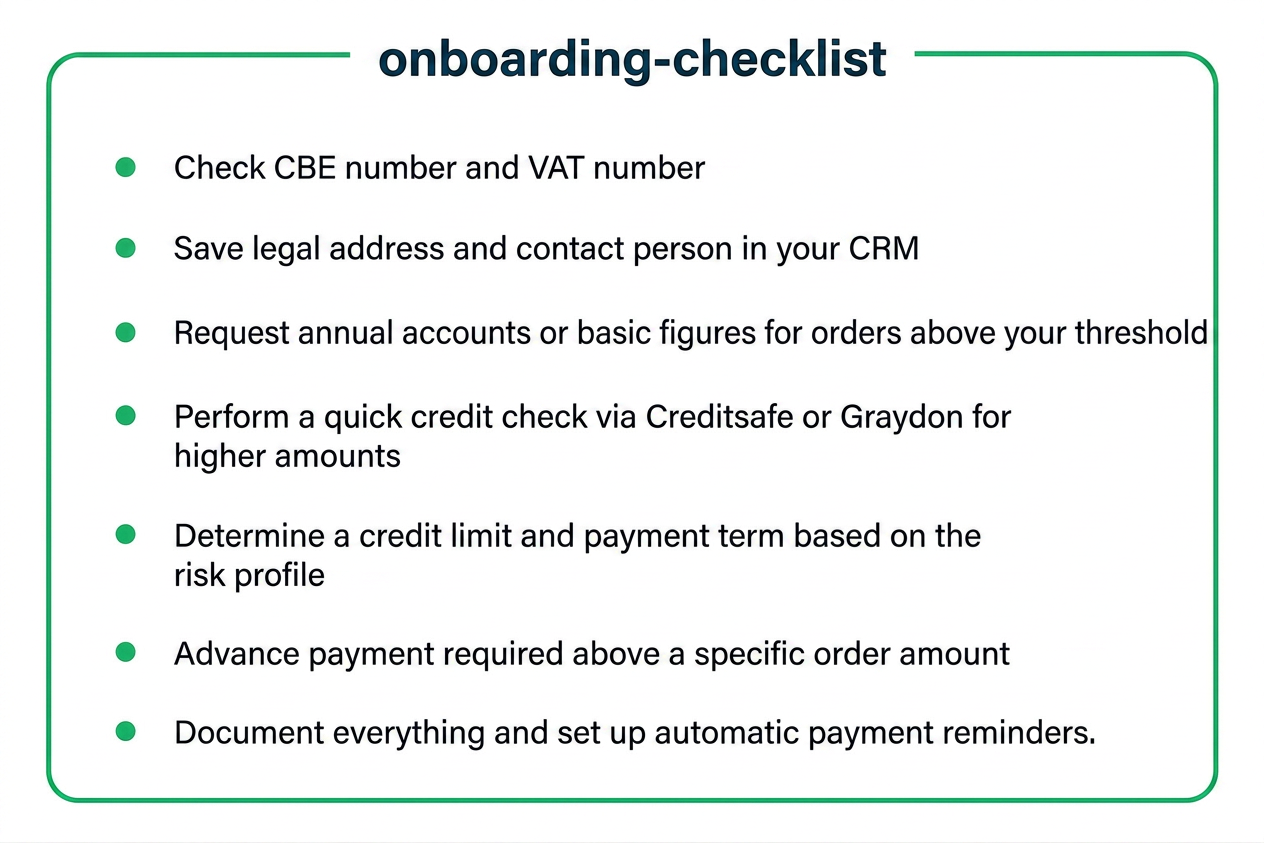
Determine in advance which information you will always request from new customers: company registration number, VAT number, the name of the regular contact person and, if applicable, recent financial statements. That is your minimum requirement. You can request this information directly from the company, but you may find that cumbersome. Through the Crossroads Bank for Enterprises (CBE), you can already obtain a great deal of information. If you are not comfortable interpreting these figures yourself, your accountant may be able to help.
Also determine in advance which payment terms you will offer depending on the risk profile. A small assignment from a customer you do not know? Ask for a 50% deposit. An existing relationship with a strong track record? Standard 30-day payment terms. This already protects you against potential non-payment by that new customer.
Step 2: Use free and public sources
You do not need to pay for a report immediately. Start with what is publicly available.
Check the company registration number through the Crossroads Bank for Enterprises (kbo.economie.fgov.be). Verify whether the name, address and business activity correspond with what your customer is telling you. A recently changed address, an activity that does not match, or a company in liquidation are concrete red flags.
Finally, perform a quick Google search on both the company and its director. Negative reviews from other suppliers, staff shortages, unpaid debts mentioned in news articles, these are signals you get for free if you take two minutes to look for them.
Step 3: Analyse the financial health of the company
For larger orders, it pays to go one step further.
The annual accounts of Belgian companies are publicly available through the National Bank of Belgium. Look at revenue trends over the past few years, the ratio between equity and debt, and how quickly the company pays its suppliers. Declining revenue combined with increasing debt is rarely a good sign.
Want to do this faster? Use a credit information service such as Creditsafe or Graydon. They can provide you within minutes with a credit score, a payment behaviour report and a recommended credit limit. It is paid information, but for orders above a certain threshold, it is absolutely worth it.
Step 4: Assess behaviour, not just figures
Figures tell half the story. Behaviour tells the rest.
If in doubt, ask for two references from existing suppliers and actually call them. One question is enough: “Do they always pay on time?” The answer, and how quickly it comes, tells you a lot.
Also pay attention to subtle signals during the sales process itself. A customer who immediately starts negotiating payment terms, who is unclear about order volumes, or who struggles to provide basic information, these are not coincidences. Take them seriously.
Step 5: Protect yourself contractually
Good screening reduces risk. Good contracts limit the damage if things still go wrong.
Make sure your general terms and conditions are clear and demonstrably accepted before you start. Explicitly state what happens in the event of late payment: the interest that applies, the fixed compensation, and your right to suspend deliveries.
For customers with a higher risk profile, ask for a deposit, a bank guarantee, or a personal guarantee from the company director. It may sound formal, but it is standard business practice. Anyone who strongly objects is already giving you a signal.
Step 6: Continue monitoring after the first assignment
Screening does not stop once the contract is signed.
Review the payment behaviour of your active customers every quarter. Who is starting to pay more slowly? Who is suddenly asking for longer payment terms? Who communicates less smoothly than before? These signals indicate a problem long before an invoice becomes truly problematic.
Always react early. At the first delay, make contact, not after two months. A quick response shows that you take the matter seriously and gives you the strongest legal position if the situation escalates later.
Conclusion: prevention is more efficient than collection
A poorly paying customer costs you more than just the outstanding amount. You lose time, energy and cash flow.
Five minutes of research via the Crossroads Bank for Enterprises and RegSol, a structured onboarding checklist and clear contracts are not bureaucracy. They are professional business practices.
But what if a customer still does not pay despite all precautions?
Through Unpaid, you can legally recover an undisputed B2B invoice, without going to court, without a lawyer and without a subscription. A bailiff at your customer's door within 5 working days, with a fixed-cost guarantee.
